A Labour government is walking toward fascism. This is the route, and how far it has already come.
Twenty-six months, dated and sourced line by line. Nothing here says the journey
is finished or that the destination has been reached. It says which direction a
Labour government has been travelling, how steadily, and who is already paying
for the distance covered.
A majority of 172. The largest Labour win since 1997.
Labour wins the general election
Fourteen years of Conservative government end. Labour takes 411 seats on a manifesto promising to restore decency to public life. Everything that follows happens under this government, and under the one that replaced it in July 2026 without a general election.
Day two. A counterpoint, and it belongs here.
The Rwanda scheme is scrapped
On his first full day in office Starmer killed the deportation scheme outright: “The Rwanda scheme was dead and buried before it started.”Not one person had ever been forcibly removed — four travelled voluntarily, and that was the whole of it. Hundreds of millions had already gone to Kigali and could not be recovered; the projected cost over six years was put at around £10bn.
This entry is here because the record would be dishonest without it. The direction described on this page is not a straight line from day one, and anyone telling you it was is selling something. Labour arrived and immediately ended the cruellest immigration policy of the previous decade. What follows is what happened next.
The lie was circulating the same day.
Southport
Three children are murdered at a dance class. The same day, a false claim that the attacker was a Muslim asylum seeker begins spreading on social media. He was born in Cardiff.
The police inspectorate later found that online misinformation helped fuel the disorder that followed.
A week of riots, and two hotels set alight with people inside
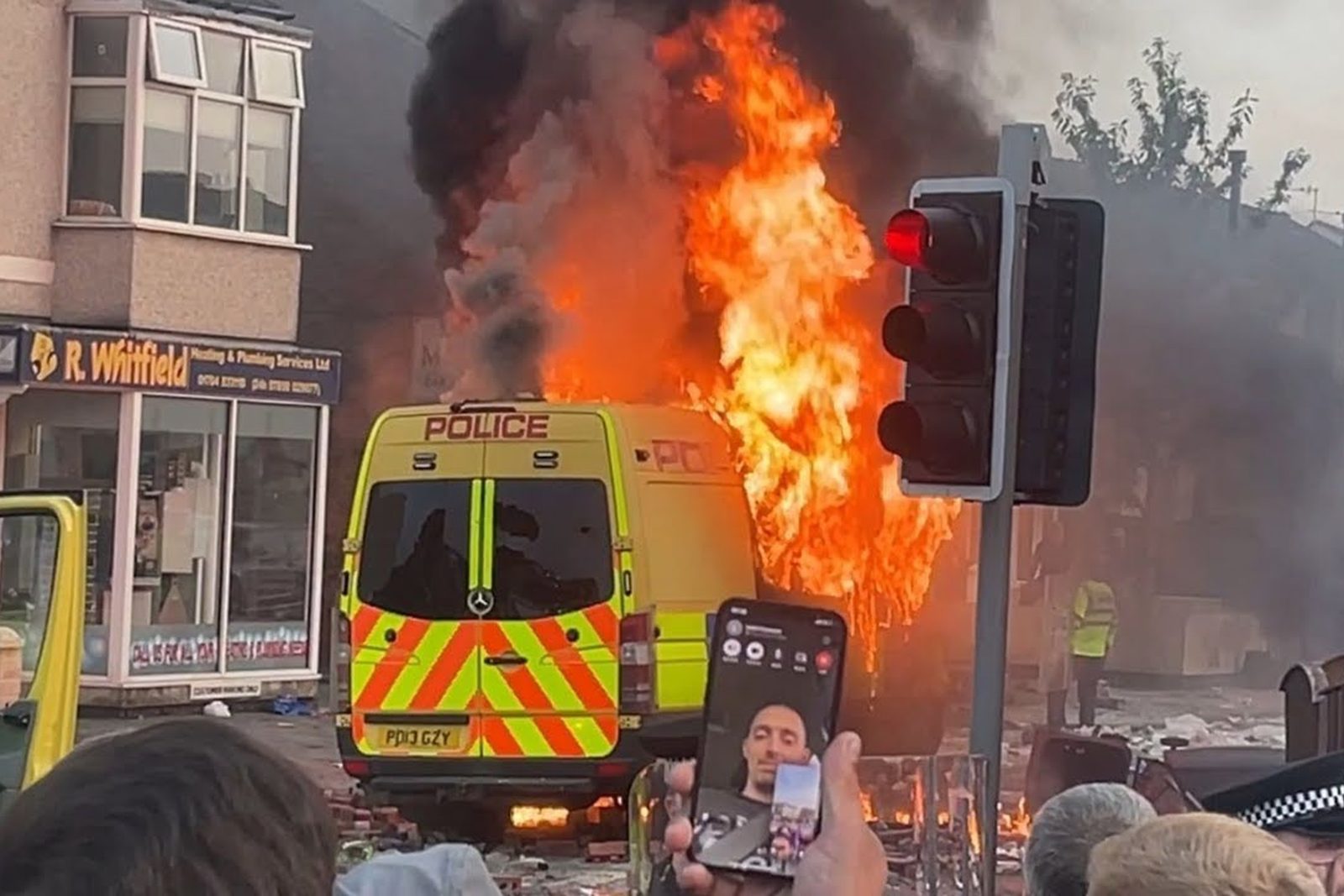
A police van on fire during the disorder in Southport, 30 July 2024.
Photograph by StreetMic LiveStream, cropped and resized,
CC BY 3.0, via
Wikimedia Commons.
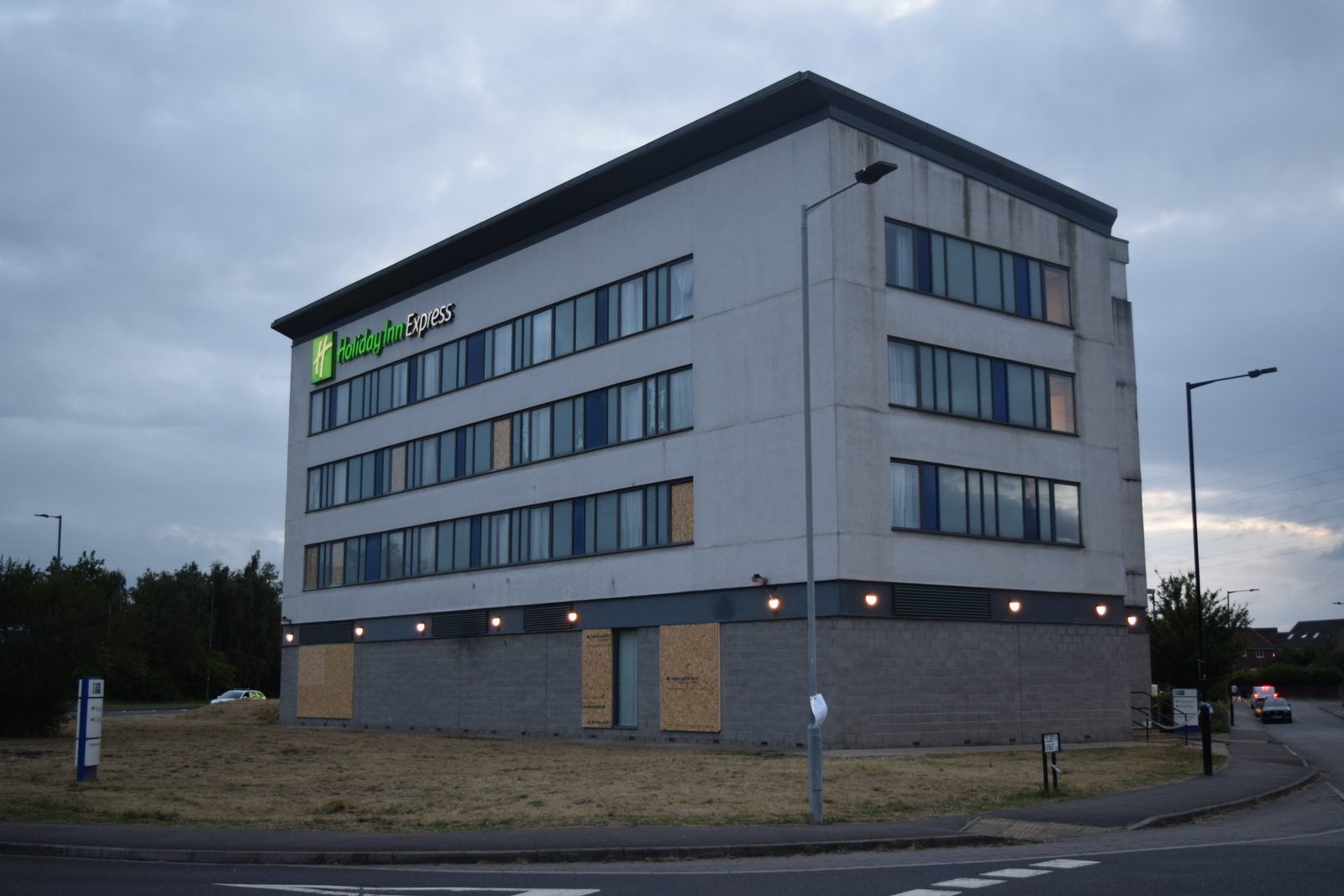
Mosques were attacked. In Rotherham and Tamworth, crowds set fire to hotels housing asylum seekers while they were still in them. In Hull, a shopping street was left boarded and burned.
This is the baseline. The state's answer to it is the thing that changes.
Holiday cancelled. COBRA convened. Courts sitting through the night.
“The full force of the law”
Starmer cancelled his holiday, convened COBRA, and put a standing army of specially trained public-order officers on notice. Magistrates' courts sat overnight. The Crown Prosecution Service was told to charge fast and charge hard.
The disorder stopped within a fortnight. Whatever else is true, the machinery exists and it is fast.
Eight days from the first petrol bomb to the first three-year sentence.
A far-right riot got you jailed inside a fortnight
The Holiday Inn Rotherham North, Manvers, on the evening of 5 August 2024 —
hours after a crowd set it alight with asylum seekers inside.
Photograph by Mtaylor848, cropped and resized,
CC BY-SA 4.0, via
Wikimedia Commons.
Derek Drummond was sentenced to three years for violent disorder on 7 August — eight days after the disorder began. Others followed within the week. It stopped.
1,000+arrested. 460 through the magistrates' courts by 16 August; 72 of those charged were children.
Not up for review until 2027.
The puberty blocker ban is made indefinite
Department of Health and Social Care11.12.2024
The ban will be made indefinite
Existing emergency measures banning the sale and supply of puberty-suppressing
hormones to under-18s remain in place and will not be reviewed until 2027. The
department cited independent expert advice of an unacceptable safety risk.
Health Secretary Wes Streeting made the emergency restriction permanent. Trans under-18s cannot be prescribed puberty-suppressing hormones, and the decision is not scheduled for review until 2027.
Labour For Trans Rights said the indefinite nature of the ban created an environment of fear and uncertainty. A Labour councillor resigned from the party over it in January.
Act two · 2025
The target starts to move
“We have let the trans community down”
Councillor Zoë Hughes resigned from the Labour Party over its acceptance of the Cass Review and the blocker ban. The first of a pattern: people leaving, not being pushed.
Six months before Palestine Action was proscribed.
Seventy-seven arrests at a march, mostly for walking the wrong way
The national March for Palestine drew a crowd organisers put at 100,000. The Met made 77 arrests — the most at any pro-Palestine march since they began in October 2023 — the great majority for breach of conditions, meaning marching outside the permitted route.
Those arrested included the demonstration’s own chief steward, Chris Nineham of Stop the War, and Ben Jamal, director of the Palestine Solidarity Campaign. Jeremy Corbyn and John McDonnell, who spoke, were interviewed under caution. Protesters said police had waved them toward the BBC and then begun arresting them; legal experts called for an independent inquiry.
This is the trajectory before the proscription existed. The instrument changed in July. The direction did not.
Regardless of how many years have passed.
Arriving by small boat becomes a lifelong presumption against citizenship
Home Office caseworker guidance was rewritten so that anyone who entered the UK without authorisation after making a “dangerous journey” — small boat, or concealed in a vehicle — will normally be refused British citizenship, regardless of the time that has passed since the entry. Caseworkers keep a residual discretion for exceptional cases; the presumption is refusal, and it does not expire.
Not a law, not a vote. A change to internal guidance on what counts as “good character”, applying to anyone who applied on or after that date. A recognised refugee, granted asylum lawfully, resident and working for a decade, now falls under a presumption of refusal that never lapses, because of how they arrived.
Campaigners argued it sat badly with the Refugee Convention. The government defended it.
Trans women with a gender recognition certificate excluded from the legal definition.
The Supreme Court redefines “woman”
The Court ruled that “woman” and “sex” in the Equality Act 2010 mean biological sex. A gender recognition certificate no longer changes the answer.
Everything in the trans strand of this timeline follows from this judgment, and from how long the government then took to say what it meant.
Seven statues. A Home Secretary statement inside 24 hours.
Graffiti on a statue gets a named criminal investigation
Home Office · Home Secretary19.04.2025
Disgraceful and unacceptable
Yvette Cooper condemned the vandalism of statues in Parliament Square.
Scotland Yard launched a criminal investigation to identify those responsible.
Seven statues were reported defaced across the day of action.
At an emergency demonstration in Parliament Square, seven statues were graffitied across the day of action — among them Millicent Fawcett and Nelson Mandela.
Paint on stone produced a personal statement from the Home Secretary and a named Scotland Yard investigation inside a day.
Reform's first councils anywhere, ever.
Reform takes 677 seats
Local elections across 23 English councils. Reform UK won 41% of all seats contested and took control of ten councils — the first it has ever held. Projected nationally, Labour would have come second on 19%, down from 34% a year earlier.
677seats to Reform. 98 to Labour.
He later said he should have read it more carefully. Then that he regretted it.
“An island of strangers”
Keir Starmer — official portrait taken in October 2025, five months after
this speech. Photograph by 10 Downing Street, cropped and resized,
Open Government Licence v3.0,
via Wikimedia Commons.
Launching the immigration white paper, the Prime Minister warned that Britain risked becoming an island of strangers. The paper proposed doubling the settlement qualification from five years to ten; it did not itself change the rules. His own MPs said it echoed Enoch Powell.
He later said he should have read the speech more carefully before delivering it, and later still expressed deep regret for the phrase itself. Polling found it lost him Labour voters and won him nobody.
Two thirds of the town's Roma population left.
Ballymena
Nine nights of anti-immigrant rioting across Northern Ireland. The homes of ethnic-minority families were burned with families inside. Police deployed water cannon and plastic baton rounds. More than thirty officers were injured in the first two nights alone.
The lasting result was not the property damage. It was that two thirds of Ballymena's Roma population left the town, on local estimates, and did not come back.
100arrests and 91 charges — the cumulative total PSNI gave five months later, in November 2025. Against an entire community displaced.
A record has to carry the things that complicate it.
The Casey audit, and the inquiry Starmer had spent months refusing
National Audit on Group-based Child Sexual Exploitation16.06.2025
Deeply disturbing
Baroness Casey found institutional failure to investigate and act, including
avoidance of the ethnicity of perpetrators for fear of appearing racist. The
government announced a national statutory inquiry days later, having previously
argued one was unnecessary.
Included because it complicates this timeline rather than because it supports
it.
Baroness Casey’s national audit of group-based child sexual exploitation found that authorities had failed to act partly out of fear of appearing racist. On ethnicity the audit was careful: national data was inadequate, and in the three police-force areas where local data existed, Asian and Pakistani men were disproportionately represented among identified perpetrators. It did not, and could not, make that claim nationally. Yvette Cooper called the findings “deeply disturbing”.
Starmer, who had resisted calls for a national statutory inquiry for months, announced one within days. Baroness Longfield was appointed chair; terms of draft terms of reference followed in December, final terms on 31 March 2026, and the inquiry was formally established on 13 April 2026 — ten months after the announcement.
This entry sits here because a record that only contains the things which flatter its own argument is not a record. Casey is the substantive failure that the “two-tier” slogan was built on top of — and the distinction between a real institutional failure and what was subsequently built out of it is the entire point. Girls were failed for years. That is true, it was the state’s fault, and it does not license a single thing in the entries that follow.
Saying you support it becomes a terrorism offence.
Palestine Action is proscribed under the Terrorism Act
Home Office · Proscription order05.07.2025
Terrorism Act 2000
Palestine Action added to the list of proscribed organisations. Membership, and
expressions of support, become offences under sections 11 to 13. Maximum penalty
for a section 12 offence: 14 years.
What triggered it: on 20 June, activists rode e-scooters into RAF Brize Norton, sprayed red paint into the engines of two Voyager aircraft and threw crowbars into the rotors. The damage was put at around £7 million. Five people were later charged with conspiracy to commit criminal damage and entering a prohibited place. Yvette Cooper moved to proscribe the organisation on 1 July; the ban took effect on 5 July, fifteen days after the break-in.
That is the government’s case, and it is a real one. The question this page asks is not whether Brize Norton happened. It is about the scope of the answer: the group was listed alongside al-Qaeda and National Action. Two offences follow. Section 13 covers wearing or displaying an article — a t-shirt, a placard — that arouses reasonable suspicion of support; it is summary-only. Section 12 covers inviting support, or recklessly expressing it, and carries up to fourteen years. Neither requires you to have been anywhere near an airbase.
What follows is the largest wave of arrests of peaceful protesters in modern British history, and about two thirds of those arrested were never charged with anything.
Two security staff seriously injured on the first night.
Epping begins
The first protest outside the Bell Hotel, after an asylum seeker was charged with sexual offences. Over the following ten weeks there would be at least nine more. Essex Police put the cost of policing 17 and 20 July alone at over £100,000.
That first night, two security guards from the hotel were attacked at a bus stop. Essex Police investigated it as a racist hate crime. The Chief Constable said the disorder had left officers and hotel staff injured, and called those responsible “thugs and vandals” — worth holding on to, because it is the word the state would decline to reach for at Dover fourteen months later.
Bottles, eggs, flour. Police vehicles vandalised.
Eight officers injured at Epping
Disorder at the Bell Hotel. A Norfolk officer was later hospitalised after being struck by a bottle. By 4 September the running total across the Epping protests stood at roughly 32 arrests.
The largest trans pride march in the world. No arrests.
A hundred thousand people march, and nothing happens
London Trans+ Pride, under the theme “Existence & Resistance”. More than 100,000 people, beating the previous world record of 60,000.
No arrests or incidents were reported in any of the coverage reviewed. The attendance figure is the organisers’, as crowd counts at marches always are.
100,000on the organisers’ count. No arrests or incidents reported in any coverage reviewed. Minimal national attention.
National Action is a proscribed terrorist organisation.
“National Action is reforming”
At a protest in Altrincham, Ryan Ferguson announced from the crowd that the proscribed neo-Nazi terrorist group National Action was reforming. HOPE not hate reported that he was arrested under the Terrorism Act days afterwards; no police, court or other primary record of that arrest could be found, and it is listed here as unconfirmed.
One arrest. Six weeks later, 857 people were arrested in a single afternoon under the same Act for sitting down with cardboard signs.
Struck with a placard. Hospitalised.
A 64-year-old counter-protester is hospitalised in Edinburgh
One of a pattern through the summer: at Epping a counter-protester was surrounded and had to be escorted out by police; at Nuneaton on 9 August the smaller counter-protest was outnumbered and led away by police rather than protected in place.
Britain First and Tommy Robinson among the backers.
Operation Raise the Colours
YouGovOctober 2025
50% read the flags as an anti-migrant message
A quarter of respondents saw them as an expression of national pride. Among
ethnic-minority respondents, 55% read them as anti-migrant or anti-minority, against
15% who read them as patriotism.
The Prime Minister's response: “I'm very encouraging of flags. I think
they're patriotic.”
Flags appear on lampposts and painted onto roundabouts across England, Scotland and Wales. Britain First's Paul Golding spoke at a flagging event; Tommy Robinson promoted the campaign. The academic George Newth assessed it as a carefully coordinated astroturf campaign.
Councils have since spent £61,770 between them taking flags down. Birmingham faces an estimated £2.6m bill for around 20,000 of them.
Reported as the first sitting MP to address one.
Suella Braverman addresses an asylum hotel protest
At Waterlooville. The Home Office had already dropped the plan on 9 August, after a petition Braverman led gathered more than 10,000 signatures and some 2,000 people protested — so this was a victory rally rather than the cause of the U-turn. She thanked the crowd for “standing up for our country”. The local council leader publicly corrected her account of the plans.
The street movement had stopped being something politicians condemned and become something they turned up to.
A founder of Combat 18 stood behind him. He posted the picture himself.
The Shadow Justice Secretary is photographed with a neo-Nazi
Robert Jenrick attended the Bell Hotel protest, organised in part by the Homeland Party, and posted about it: “Great to be with peaceful, patriotic protesters in Epping today.”
Standing directly behind him in the photograph was Eddy Butler — former National Front and BNP, and a founder of Combat 18, the neo-Nazi terror squad that ran a campaign of violence against minorities and left-wing activists in the 1990s. Butler posted his own copy of the picture, captioned “At the Bell Hotel riding shotgun for Robert Jenrick, pretender to the Tory party leadership.”
A source close to Jenrick said he had no idea who Butler was. Five months later Jenrick joined Reform.
The councils moved first. Then they were left on their own.
Councils start taking the flags down, and become the story
Within a fortnight of the campaign starting, the flags were on motorway roundabouts, bridges and lampposts twenty-five feet up. Birmingham City Council was the first to remove them en masse, on the grounds that people climbing street furniture were putting themselves and motorists at risk. Tower Hamlets said it would take down the St George’s flags in its borough “as soon as possible”.
This is the part that gets forgotten. For a fortnight the argument was local: councils applying highways rules, and a campaign daring them to. Right-wing outlets ran it as leftist councils versus patriotism; the Conservative leader called the removals “shameful”.
The councils were carrying it alone, and it cost them. Birmingham spent nearly £16,000 on removals between January 2025 and April 2026 and later went to the High Court; Oxfordshire spent around £25,000 removing some 872 unauthorised attachments before winning the first full injunction.
What did not arrive was any backing from central government. What arrived instead, twelve days later, was the Prime Minister and the Home Secretary on breakfast television describing their own flags.
Four days before 857 people were arrested for sitting in a square.
The government’s answer to the flag campaign was to compete with it
BBC Radio 5 Live & BBC Breakfast02.09.2025
We actually have Union Jack bunting on our garden shed at the moment
Yvette Cooper, Home Secretary, on BBC Breakfast. The same morning the Prime
Minister told Radio 5 Live he was “very encouraging of flags” and that
he had one up at home. Both were answering questions about a flag campaign
organised in part by Britain First and promoted by Tommy Robinson.
Critics called the response “parody territory”. One month later
YouGov found 50% of the public — and 55% of ethnic-minority respondents — read the
flags as an anti-migrant message.
Asked on BBC Radio 5 Live about people putting flags up in response to the asylum hotel protests, the Prime Minister said he was “very encouraging of flags”, that they were patriotic, and that they should not be “devalued and belittled”. He noted he had put the Union Jack on Labour membership cards and kept a St George’s flag in his flat above Downing Street. He posted that he had “proudly got one up at home”.
The same morning, on BBC Breakfast, the Home Secretary — the minister responsible for policing — volunteered an inventory of her own: “We actually have Union Jack bunting on our garden shed at the moment. I’ve got St George’s flags, I’ve got St George’s bunting, I’ve got the Yorkshire rose bunting as well, I’ve got Union Jack flags and tablecloths.”
The campaign they were responding to had been running for a month, organised in part by Britain First and promoted by Tommy Robinson. Within weeks half the country would tell YouGov they read those flags as an anti-migrant message. The government’s response to a far-right street campaign was not to confront it but to audition on its chosen ground.
Labour MP Ian Byrne, the same day: “Flags don’t feed families. Flags don’t fix the housing crisis.” At conference in October the cabinet was photographed holding flags, and the leader’s speech was built around patriotism.
Two days after the flag interviews. Almost no notice.
The main safe route for refugee families is suspended
Home Secretary Yvette Cooper suspended new applications to the refugee family reunion route with effect from 3pm the same afternoon. It was the route by which a recognised refugee could bring a partner or children to join them without fees, income thresholds or language tests. In practice it was the main lawful way for a child to reach a refugee parent.
Applicants were redirected to the standard family migration rules: fees, the immigration health surcharge, and a minimum income requirement. The government called the route no longer financially sustainable or fair, and said smugglers were using it to advertise crossings. It described the suspension as temporary, pending new rules in spring 2026.
Safe Passage International was later granted permission for judicial review. Closing a safe route, and giving dangerous journeys as the reason, is a particular kind of argument.
6 & 13 Sep 2025 · entry 29
Two Saturdays, one week apart
Same city. Same police force. Same government. The only thing that changed was who was standing in the square.
Amnesty International · Urgent ActionEUR 45/0273/2025
857 protestors arrested in one day
857 arrests under the Terrorism Act in a single day, with 33 further
arrests for other offences. Amnesty, which put observers on the ground,
disputed the characterisation of the protest as violent.
No freely-licensed photograph of either demonstration exists. The record
stands in for the picture.
Read the original.
Saturday 6 September
More than 1,300 people sat down in Parliament Square holding cardboard signs.
Officers deployed
2,500
Arrests on the day
890
Officers hurt
None seriously
Saturday 13 September
Between 110,000 and 150,000 marched with Tommy Robinson.
Officers deployed
1,000
Arrests on the day
25
Officers hurt
26 on the day
Two and a half times the officers went to the silent one, and it produced
roughly thirty-five times the arrests. The demonstration where twenty-six
police officers were hurt is the one where almost nobody was detained for it.
All four figures are as reported on the day.
The Met’s later reconciled totals differ — 23 arrests and 37
injured officers for 13 September — because march-related charges keep
arriving for months. The gap does not close.
What this comparison does not prove
The two offences are not alike, and the gap is partly mechanical. On
6 September, holding the sign was the offence: no evidence beyond
presence was needed, and Defend Our Juries organised it precisely so that
mass arrest would be unavoidable. On 13 September, an arrest required
identifying a particular person doing a particular unlawful thing in a crowd
of over a hundred thousand — slower work, and some of those charges landed
weeks later. Mass-arrest policing also needs more officers per protester
than crowd containment does.
None of that accounts for the whole gap, and none of it is why this pair is
on the page. Two Saturdays are an illustration, not a proof. The pattern
underneath them is the evidence:
251anti-migrant protest events across 77 locations, June–December 2025. 1,280 arrested, 796 charged — across seven months and the entire country.
857arrested in one afternoon, in one square, sitting down.
What was left on York Road afterwards, photographed on 15 September 2025.
Photograph by Doyle of London, cropped and resized,
CC BY-SA 4.0, via
Wikimedia Commons.
Eight days after Unite the Kingdom. A fortnight after the 857.
The United Kingdom recognises the State of Palestine
Starmer announced formal recognition, over provisional 1967 borders with equal land swaps, alongside Canada and Australia. The United States and Israel objected.
It belongs on this page for the same reason the Rwanda entry does: it is the other half of the picture, and leaving it out would make this a case rather than a record. The same government that recognised Palestinian statehood in September had in July made it a terrorism offence to say you support a group that spray-painted an aeroplane about it, and had arrested 857 people in a single afternoon for holding signs a fortnight earlier.
Both things are true at once. That is what makes it worth writing down.
A mosque burns in Peacehaven.
Arson, amid polling on what the flags were saying
The Peacehaven mosque arson came in the same month YouGov found half the country reading the flag campaign as an anti-migrant message. Businesses that objected to flags were targeted with review-bombing; healthcare workers reported a rise in racist incidents.
It was not isolated. The British Muslim Trust — the government’s own partner for monitoring anti-Muslim hatred — later verified 27 attacks on mosques in the three months to October, and found that 40% involved nationalist symbols or slogans such as “Christ is King”. Its report placed the surge squarely in the context of Raise the Colours and the Unite the Kingdom rally, and described the flag itself becoming a tool of ethno-nationalist intimidation.
Permission granted in July. Heard in November. Decided in February.
The proscription is challenged
Huda Ammori was granted permission for judicial review on 30 July 2025; the three-day substantive hearing ran in November. By the time it was heard, more than two thousand people had already been arrested under the ban.
Human Rights Watch: “breaks Labour's promises”.
The government proposes making refugee status temporary
Human Rights Watch21.11.2025
Mahmood's immigration plan breaks Labour's promises
The reforms mark a retreat from the approach Labour promised voters. Refugees
would face repeated review of their status and a two-decade wait for permanent
settlement.
Home Secretary Shabana Mahmood's “Restoring order and control” paper proposed cutting refugee protection to a 30-month temporary status, reviewable and revocable once a home country is deemed safe, with a 20-year wait for settlement.
Labour MPs accused their own Home Secretary of aping Reform UK. These were proposals, not law: implementation depended on legislation and rules changes, and the Bill did not arrive until June 2026.
The month before, Starmer had called Reform’s plan to strip settled migrants of indefinite leave to remain “racist and immoral”, and said it would tear the country apart. His own government then tightened the same status: high-standard English, a clean record, work, national insurance, no benefits, and community volunteering.
A man dies falling from a ladder in Bristol.
The flag campaign goes to France
Raise the Colours members travelled to France on vigilante trips with associates of Tommy Robinson. In Bristol, a man died falling from a ladder while putting a flag up.
Promised January 2024. In the King's Speech. Still not law.
The conversion therapy ban is debated again, and does not happen
Starmer promised a trans-inclusive ban in January 2024. A draft bill was announced in the 2024 King's Speech. Ministers said in June 2025 it would come “within the next nine months”.
Eight years after a ban was first promised by a Conservative government, there is still no law. Campaigners note that every month of delay leaves people exposed to practices the government itself calls abusive.
Act three · 2026
The state stops turning up
An ice axe through a gallery window.
A fortnight of ordinary weeks
From the Institute of Race Relations' running calendar, a single two-week stretch: on 16 January an art installation about migration was attacked with an ice axe; on 17 January the Muslim Women's Network stripped the signage from its offices and the staff photographs from its website after threats; on 20 January a police officer at Epping was temporarily blinded by a laser.
A street in Dundee had been under nightly intimidation since November.
The opposition did not lose the argument. It changed sides.
Four Conservative MPs cross to Reform, and the racist right stops being fringe
Danny Kruger (East Wiltshire) went first, in September 2025 — the first sitting Conservative MP ever to defect to Reform. In January 2026 three more followed inside a fortnight: Robert Jenrick (Newark), hours after Kemi Badenoch sacked him; Andrew Rosindell (Romford) two days later; and on 26 January Suella Braverman.
Braverman’s constituency is Fareham and Waterlooville — the same Waterlooville where, five and a half months earlier, she had become the first sitting MP to address an anti-migrant hotel protest. She took the seat with her.
This is the mechanism that matters, and it is not about Labour. Positions that were the property of the far right in 2024 — the hotel protest, the flag campaign, mass deportation — did not stay there. They were picked up by shadow cabinet ministers, carried into a party polling at 29%, and thereby made ordinary. Jenrick had stood at Epping in August. Badenoch called councils removing the flags “shameful”.
By the time a Labour government is competing on the same ground, there is no longer an opposition arguing the other way. That is what normalisation is: not everyone agreeing, but the disagreement disappearing from the room.
An amendment on anti-LGBTQ+ hate crime
The government tabled an amendment to the Crime and Policing Bill to make hate crimes against LGBTQ+ people an aggravated offence. Recorded transgender hate crime had risen 50% over five years.
The ban stayed in force throughout. So did the arrests.
A court ruled the ban unlawful. The arrests carried on regardless.
High Court of Justice · King's Bench Division13.02.2026
The proscription was unlawful
The Court upheld the claimant's challenge that the Home Secretary failed to
comply with her own policy in making the decision to proscribe, and that the
proscription breached the rights to freedom of expression and assembly protected by
Articles 10 and 11 of the European Convention on Human Rights.
The High Court held that the proscription of Palestine Action was unlawful: the Home Secretary had failed to follow her own policy, and the ban breached freedom of expression and assembly under Articles 10 and 11.
The ban did not lift. It stayed operative pending appeal, and on 15 June the Court of Appeal reversed the ruling outright, a five-judge panel granting the Home Secretary wide latitude on national security. So the arrests were lawful throughout — that is precisely the point. For four months the state went on arresting people under a proscription its own High Court had found to have been decided unlawfully, and nothing about that required it to pause.
2,700arrested in the ban’s first five months, per reporting in December 2025 — around 254 of them charged with terrorism offences. The total passed 3,000 by April 2026.
Children racially abused. Mosques attacked.
The hard right keeps rising
Attacks on mosques and racial abuse of children continued to climb through the winter, eighteen months after the Southport riots that were supposed to have been answered.
Joint third on the BBC's projected national share. Behind the Greens.
Labour loses 1,498 councillors in a night, and finishes behind the Greens
Final figures: Reform gained 1,452 seats and 14 councils. Labour lost 1,498 councillors and 38 councils. On the BBC’s projected national share Labour came in on 17% — behind the Green Party on 18%, and joint third with the Conservatives. Local elections do not produce a straightforward national vote share; this is a projection, and it is the worst one the party has had.
Six weeks later the Prime Minister was gone.
−1,498Labour councillors. −38 councils. Reform +1,452 seats and 14 councils.
Around 60,000 marched again. This time the Met deployed four thousand officers — four times the number sent to the march of 150,000 eight months earlier, a crowd two and a half times this one’s size — largely to keep it apart from a pro-Palestine march on the same day.
Four thousand officers were available when the operational priority was keeping two crowds apart. Eight months earlier, for a march two and a half times the size, the deployment was a quarter of that.
Signed against by more MPs than any comparable motion. It took effect anyway.
The EHRC code is laid before Parliament
Equality and Human Rights Commission21.05.2026
Toilets designated male or female should be for those of that biological sex
Trans people are directed to accessible, lockable or unisex facilities. The code
follows the Supreme Court ruling of April 2025 and was laid before Parliament under
the negative procedure: it takes effect unless actively disapproved within 40 days.
Supported by Andy Burnham, who became Prime Minister two months later.
Trans people directed to “accessible, lockable or unisex” toilets. Nadia Whittome’s motion to disapprove it gathered signatures across Labour, Lib Dem, SNP, Green, Plaid Cymru, SDLP, Your Party and independent benches — just over a hundred by early June, and 167 by the time the code took effect in August.
Under the procedure, a code comes into force unless a House actively votes it down. It did not. It came into force.
“Pogrom” here is The Times’s word, and the Irish Times’s, and the SDLP leader’s.
Belfast: lists of addresses, and thirty-five arrests
Northern Ireland Office · Secretary of State11.06.2026
People being burnt out of their homes because of the colour of their skin. There is no justification for that.
Hilary Benn, on the third night of disorder. The PSNI described the circulation
of lists of immigrants' home addresses on social media as “totally
unacceptable”.
No freely-licensed photograph of these nights exists.
Read the reporting.
After a stabbing on 8 June, organised groups went door to door. Lists of immigrants' home addresses circulated on social media; the PSNI called this “totally unacceptable”. The fire service attended sixty-two incidents across Greater Belfast in a single night. 168 officers had to be shipped in from Great Britain to support the PSNI, and 49 officers were injured.
SDLP leader Claire Hanna called it a race-based pogrom. The Times and the Irish Times used the same word. In July the PSNI told a Commons committee that paramilitary members had been present and in some cases had directed the violence.
Five thousand people marched against racism in Belfast on 13 June: “Riots don't speak for Belfast.”
27people burnt out of their homes, including a family with a two-month-old baby.
35arrests by 7 July, per PSNI evidence to Parliament — five of them juveniles. Against 27 people burnt out of their homes and 49 injured officers.
The order never stopped operating. Only the reasoning was ever in doubt.
The Court of Appeal upholds the ban
A special five-judge panel found the proscription lawful and proportionate, affording the Home Secretary wide latitude. Huda Ammori was later granted permission to appeal to the Supreme Court.
To be precise about what the four months between the judgments were and were not: the proscription order remained in force throughout, so every arrest made under it was lawful. What the High Court had found unlawful was the decision to proscribe — and that finding changed nothing on the street. People went on being arrested at the same rate, under an order whose making a court had just condemned, until a higher court said the making had been fine after all.
Net approval −42 the week before he went.
Starmer resigns
Opinium · Voting intention03.06.2026
Net approval: −42
Opinium recorded Starmer at −42 in the week before he resigned, and
−44 in April. Voting intention that week: Reform 29%, Labour 20%,
Conservatives 17%.
Two years less a fortnight after the landslide. The trigger was Reform's surge and the May local elections.
He announced in September that he would stand down as an MP.
£2.6m to remove 20,000 flags in Birmingham alone.
Councils start going to court over the flags
On 23 June 2026 Oxfordshire County Council obtained a High Court injunction against unauthorised attachment of flags to street furniture, after spending some £25,000 removing around 872 of them. Birmingham applied for its own in August 2026.
Royal Assent in April. In force at the end of June. Very little coverage.
Masks, flares and cumulative disruption: the protest powers become law
Crime and Policing Act 2026 · Part 1029.06.2026
Cumulative disruption
A senior police officer must consider the cumulative disruption caused by
previous protests in the area when imposing conditions on a new one, whether or not
those protests were organised or attended by the same people, or concerned the same
cause. New offences: concealing identity in a designated area, possessing
pyrotechnics, climbing war memorials. The mask offence applies only within a
locality designated by a senior officer.
The same Act contains the amendment making anti-LGBTQ+ hate crime an aggravated
offence. Both were passed together.
Part 10 of the Crime and Policing Act 2026 came into force. Police can now designate “mask-free zones” in which concealing your identity at a protest is a criminal offence. Possessing pyrotechnics at a protest is an offence. Climbing on war memorials is an offence.
The provision that matters most got the least attention. Section 165 requires a senior officer to consider the cumulative disruption of previous protests when deciding whether to impose conditions on a new one — regardless of whether those earlier protests were organised by the same people, attended by the same people, or about the same subject.
Liberty’s reading is that this lets a force ration protest in an area: not by banning a demonstration on its own merits, but by counting the ones that came before it. The powers arrived fourteen days after the Court of Appeal upheld the Palestine Action ban.
The mask offence is not automatic: it bites only inside a locality a senior officer has designated, and only while that designation is running. So when several hundred masked men closed the Port of Dover ten weeks later, the question was never whether a law existed. It was whether anyone chose to switch it on.
The Immigration and Asylum Bill is introduced
Mahmood put the November proposals into a bill: temporary protection, the twenty-year settlement wait, and returns once a home country is deemed safe.
A new leader. The same code of practice.
Andy Burnham becomes Prime Minister
Elected Labour leader on 17 July, Prime Minister on 20 July, without a general election.
He supported the EHRC code. The leader changed; the policy did not.
The largest trans pride event anywhere, ever. Peaceful.
A hundred and fifty thousand people march, and are called a festival of violent bigotry
London Trans+ Pride, under the theme “Our Future, Our Fight”. Up from the organisers’ 100,000 the previous year. Peaceful, again, with no arrests or incidents reported in the coverage reviewed.
spiked headlined its coverage “a festival of violent bigotry”. In fairness to it, the piece alleges no assaults and no arrests — “violent” is doing rhetorical work about placards and chants. That is the thing worth noticing. A march of 150,000 people at which nothing happened still drew the vocabulary of violence; a coordinated blockade of a national port six weeks later drew “spontaneous”.
150,000on the organisers’ count — the largest trans pride march in the world. No arrests or incidents reported.
134 of them under section 12.
Another 152 arrested
A year after the ban, and six weeks after the Court of Appeal restored it, the arrests continued at the same rate. Amnesty's observers again found the protest entirely peaceful.
Three hundred and sixty-four days after the 857.
Masked men closed Britain’s busiest port, and nobody was arrested
Kent Police · Statement05.09.2026
A spontaneous protest
The force said no arrests had been made, that traffic was flowing normally and
that everyone involved had dispersed by midday. Several hundred men had arrived in
hired vans, in matching black clothing and balaclavas, and closed every road into
the port simultaneously.
Estimates ran from 300 to 600. They arrived in hired vans, dressed head to foot in black with their faces covered, and linked arms across every road into the Port of Dover. Four miles of stationary traffic for most of the morning. The protesters were seen boarding a train home at Dover Priory before midday, and the roads reopened behind them.
Labour's own leader of Dover District Council called the operation “exceptionally well organised”. A Labour MP said a clearly coordinated protest should never have been described as spontaneous. Even Nigel Farage said people should not be allowed to mask up and blockade a road.
As of publication, two days later, no arrests had been made. Identification-based charges from large public-order events often land weeks afterwards, so that may change, and this entry will be updated if it does. What is already on the record is the description: not “we are gathering evidence”, but “spontaneous”.
0arrests.
Twenty-three affordable flats, for people already on the local waiting list.
A Glasgow tenement is burned down over a lie about who would live in it
Scottish Fire and Rescue Service · Stonyhurst Street06.09.2026
Deliberate
Six appliances attended a fire in a four-storey derelict tenement in Possilpark
from about 16:50, with crews still in attendance the following day. The block was
mid-refurbishment into 23 affordable homes for the NG Homes waiting list. It had
never been designated for asylum accommodation.
The third incident in three days, in the third city.
A derelict block on Stonyhurst Street in Possilpark, empty for around twenty years, was being refurbished into 23 affordable flats — some £3m of investment in one of the poorest parts of the city, for households already on the local housing association’s waiting list.
Online, it was said to be for asylum seekers. It was not, and never had been. On the evening of 6 September it was deliberately set alight. Six appliances attended; crews were still there the following day. Far-right accounts celebrated.
The local MSP, Paul Sweeney, put it plainly: “The idea that it is somehow for strangers is completely wrong. We need to nip this in the bud before things go out of control any further.”
Note the word he had to reach for. Sixteen months after a Prime Minister warned from a Downing Street lectern about an island of strangers, a Glasgow MSP was standing in front of a burnt-out building explaining that the people due to live in it were not strangers at all. They were neighbours, and the flats are gone.
This time there were riot shields. Twenty-four hours later.
Portsmouth, the next night
Cabinet Office · Government spokesperson07.09.2026
We condemn the intimidating and thuggish behaviour we are seeing tonight
Issued in the early hours, as protesters in Portsmouth confronted officers
carrying riot shields. Hampshire Police imposed a dispersal order and urged the
public to avoid the area. The previous day’s blockade at Dover had been
described by Kent Police as a spontaneous protest, and produced no arrests.
Compare the wording with entry 48. The behaviour did not change overnight; the
description of it did.
A dinghy carrying around 140 people — one of the longest small-boat crossings recorded — came ashore at Portsmouth. Hundreds of protesters, again dressed largely in black and many masked, gathered to meet the coach carrying them. Officers faced them with riot shields.
The response was not the response to Dover. Hampshire Police put a dispersal order in place, warning that anyone refusing to comply could be arrested. A government spokesperson condemned the scenes the same night: “We condemn the intimidating and thuggish behaviour we are seeing tonight.”
Three days, three cities: a port closed in Kent, social housing burned in Glasgow, a coach met by a crowd in Hampshire. Dover was a blockade that succeeded; Portsmouth was a confrontation that was held. The tactic was recognisably the same — coordinated, masked, at a port — and the response was not. One day after a national port was closed and called spontaneous, riot shields, a dispersal order and a government statement arrived before midnight. Something moved. Whether it moved in time is the open question this timeline ends on.


_002.jpg)
.jpg)
.jpg)